
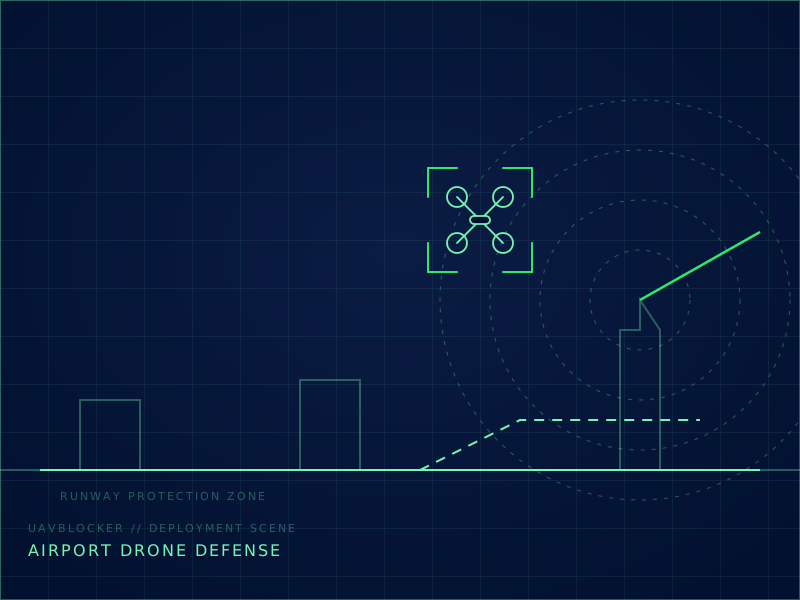
Threat profile
Consumer and commercial drones entering the control zone, accidentally or deliberately; FPV drones approaching approach and departure corridors; repeat sightings that exploit slow manual response.
Recommended layered architecture
| Layer | How it works on this site type |
|---|---|
| Detect | Ku-band radar heads on elevated airfield positions plus passive RF monitoring cover approach corridors and the perimeter without emitting into controlled airspace. |
| Identify | RF classification names the likely drone family; auto-cued EO/IR cameras give operators visual confirmation and evidence. |
| Track | The UB-C2 platform fuses tracks onto the airfield map with geofenced zones around runways and terminals. |
| Defeat | Directional jamming aimed away from runways and navigation aids, authorized per airport procedure; net capture is reviewed where debris control matters. |
Recommended product mix
- UB-RD Series Ku-Band Drone Detection Radar
- UB-RF Series RF Drone Detection And Direction Finder
- UB-EO Series EO/IR Drone Tracking Camera
- UB-C2 Counter-UAV Command Platform
- UB-GUN Series Portable Anti-Drone Jammer Gun
Deployment notes
Radar and RF sensors mount on towers, terminals, or masts with clear line of sight along approach corridors. Detection coverage is tuned to give security teams several minutes of warning before a drone reaches the runway zone.
Compliance note
Countermeasures at airports are coordinated with the civil aviation authority and spectrum regulator. Many airports deploy a detection-first configuration and add defeat capability under a formal authorization framework.
Site adaptation for Global
Deployments are configured around the protected site: perimeter length, approach directions, existing security systems, and local spectrum rules.
| Site power | AC 110-240 V, 50/60 Hz site power, with DC vehicle and battery options by model |
|---|---|
| Documentation | Export-control review and end-user documentation are completed before quotation |